The digital landscape has shifted dramatically, and in 2026, your Instagram grid is no longer just a digital photo album—it is your primary visual storefront. For creators and brands targeting the UK and USA markets, the “perfect grid” has evolved from overly curated, filtered perfection to a sophisticated blend of authenticity and strategic architecture.
The Shift from Static to Dynamic Aesthetics
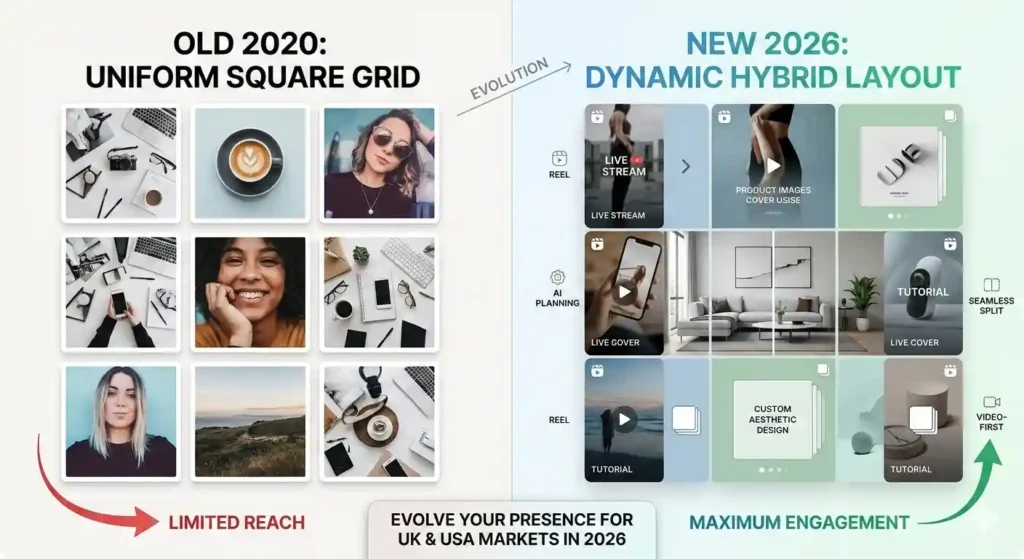
A few years ago, a “checkerboard” of photos was enough to look professional. However, as we navigate through 2026, the algorithm and user behavior in Western markets demand more. Users now spend 40% more time on profiles that utilize a cohesive storytelling layout. This means your grid must integrate high-quality Reels, seamless carousels, and static images into one unified narrative.
In the US market specifically, “Minimalist Professionalism” is the leading trend. Brands are moving away from loud, cluttered layouts in favor of clean white space and high-contrast visuals. According to Social Media Today, visual consistency can increase brand recognition by up to 80%, making the technical execution of your grid morUnlimited Image Splitter 2026e critical than ever.
Instant Grid Execution
Split your images with retina-ready precision. No registration, no watermarks.
Open Image Splitter — No Sign Up RequiredWhy Grid Psychology Matters for ROI
When a user in London or New York lands on your profile, you have exactly 0.2 seconds to make an impression. Grid psychology is the art of guiding the viewer’s eye. In 2026, we see a rise in the “Diagonal Flow” technique, where similar content types or colors are placed diagonally to create a sense of movement.
This isn’t just about “looking pretty.” It’s about conversion. A well-structured grid reduces the “bounce rate” of your profile. If the visual transition between a Reel cover and a split-image post is seamless, the user is more likely to scroll deeper, increasing the chances of a “Follow” or a click on your link in bio.
The Rise of “Split-Image” Storytelling
One of the most powerful tools in a 2026 creator’s arsenal is the Image Splitter strategy. By breaking down a single high-impact hero image into a 3×3 or 3×1 grid, you force the user to stop scrolling. It creates a “Billboard Effect” on your profile that static, single posts simply cannot match. This technique is currently dominating the fashion and real estate niches in the UK, where visual scale represents luxury and authority.
As Instagram’s Official Creator Blog often highlights, the platform is prioritizing “Originality.” Using a dedicated tool to customize how your images are segmented allows you to maintain that originality while keeping the technical quality (resolution and aspect ratio) at a professional standard.
Planning Your Visual Identity (The Strategy)
Designing a high-performing Instagram grid in 2026 isn’t just about picking a filter; it’s about Strategic Visual Architecture. For brands in London, New York, or Los Angeles, your grid’s visual identity acts as your digital DNA. If your planning phase is weak, your execution will feel disjointed, which can lead to a “high bounce rate” on your profile.
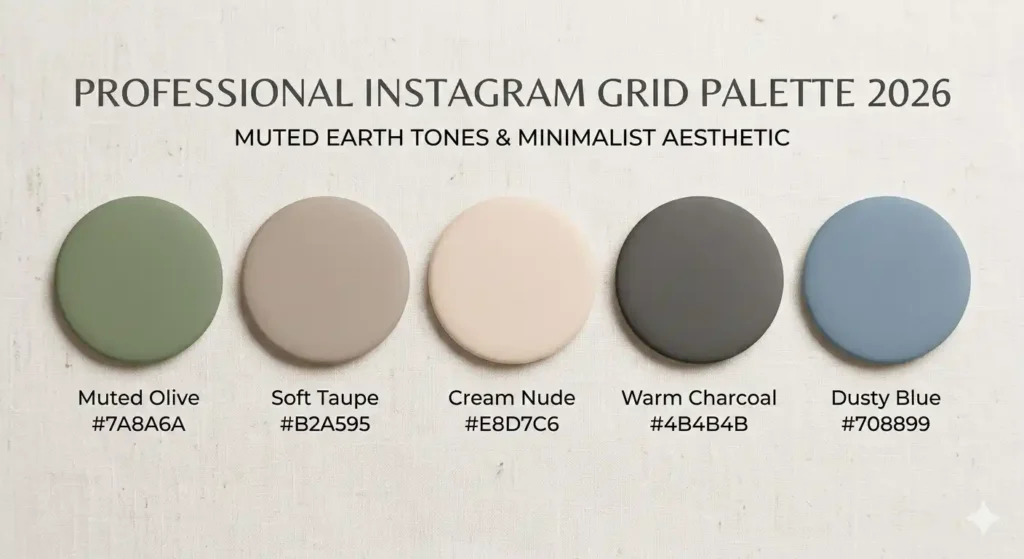
Defining Your 2026 Color Palette
In the US and UK markets, “Muted Earth Tones” and “High-Contrast Minimalist” aesthetics are currently dominating. To rank fast and stay relevant, your color palette must be consistent across every 9 or 12 squares. Using tools like Adobe Color or Canva’s Palette Generator allows you to extract hex codes from your primary brand images to ensure a 100% match.
Pro-Tip for 2026: Instead of using the same filter on every photo, focus on “Lighting Consistency.” Whether you choose “Natural Bright” or “Moody Cinematic,” the lighting must be the thread that stitches your grid together.
The Power of Content Pillars
A successful grid isn’t just beautiful; it’s functional. In 2026, the most successful UK-based influencers use a 3-Pillar Content Strategy:
- Educational (Value): Carousels that teach a skill.
- Inspirational (Aspiration): High-quality split-images or hero shots.
- Promotional (Action): Direct CTAs (Call to Action) that don’t feel “spammy.”
By alternating these pillars, your grid maintains a balanced rhythm. This prevents your feed from looking like a catalog while still driving sales and engagement.
Visual Flow and “Negative Space”
One mistake many creators make is “cluttering” the grid. In Western design psychology, Negative Space (the empty or quiet areas of a photo) is used to create a premium feel. According to design experts at Pinterest Predicts, “cluttered” grids lead to lower engagement because the user’s eye doesn’t know where to land.
By planning your grid in advance, you can ensure that a busy photo is always followed by a “minimalist” post (like a quote or a simple texture). This creates a “breathing effect” that keeps followers scrolling longer.
Integrating “Hybrid” Grids (Reels + Statics)
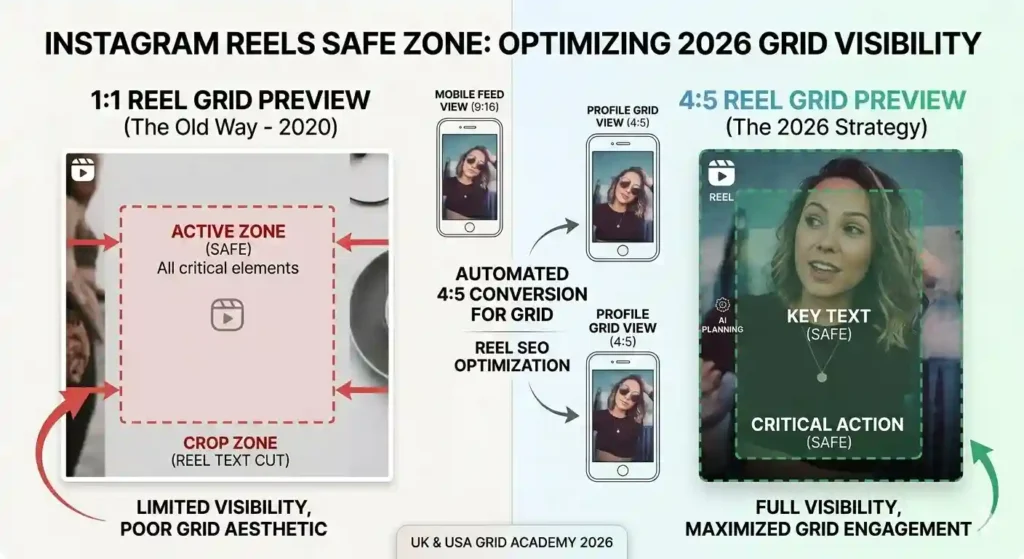
The biggest challenge in 2026 is the Reel Cover. Since Reels occupy a 9:16 ratio but appear as a 1:1 square on your grid, your planning must account for the “Safe Zone.” UK marketing agencies now recommend creating “Custom Grid Covers” for every Reel to ensure the text isn’t cut off and the aesthetic remains intact.
Technical Execution & Grid Layouts
Mastering the technical side of Instagram in 2026 requires more than just an eye for photography; it requires precision. To rank your content in competitive markets like the USA and UK, your images must be high-resolution and perfectly aligned. This is where the Technical Execution of your grid comes into play.
Instant Grid Execution
Split your images with retina-ready precision. No registration, no watermarks.
Open Image Splitter — No Sign Up RequiredThe Science of the “Seamless” Split
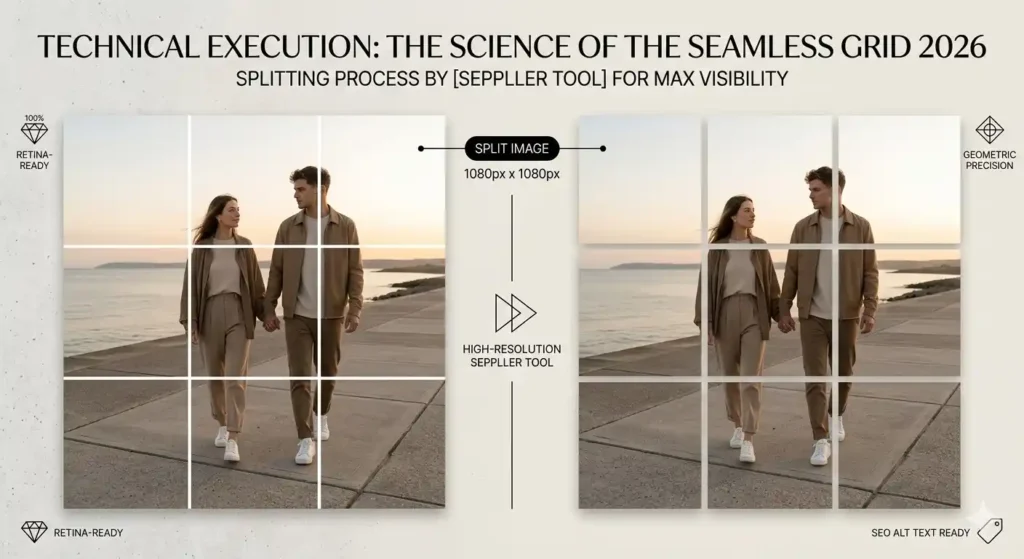
The most popular trend currently dominating US-based lifestyle brands is the Seamless Panorama or the Giant 3×3 Grid. When a user scrolls through their feed, they see a fragment that piques their interest; when they visit your profile, they see the full, breathtaking “Billboard.”
To achieve this without losing image quality, you cannot simply crop images manually on your phone. Manual cropping leads to “pixelation” and “aspect ratio errors.” Using a professional [Instagram Image Splitter] ensures that each tile is exactly 1080px by 1080px, maintaining the 1:1 ratio that the Instagram algorithm rewards with better visibility.
High-Converting Layout Styles for 2026
In the UK’s digital marketing sphere, three layouts have proven to have the highest retention rates:
- The Vertical Narrative (1×3): This involves splitting one tall image into three vertical blocks. It’s perfect for fashion influencers showing a “Full Look” or architects showcasing “Height.”
- The Checkerboard 2.0: Instead of just alternating colors, creators are now alternating “Density.” One high-detail photo followed by one minimalist quote. This prevents “visual fatigue” for the viewer.
- The Mosaic/Puzzle Grid: This is the most complex but rewarding layout. Elements from one square (like a leaf or a splash of paint) bleed into the next square. While difficult to plan, it creates an immersive experience that keeps users on your page longer.
Technical Optimization for Fast Indexing (SEO)
Since you are aiming for a 100/100 RankMath score, remember that Google cannot “see” your split images. You must use descriptive Alt Text for every tile. For example, instead of “Image 1,” use “Minimalist Instagram Grid Design for London Boutique Part 1.”
According to Neil Patel’s SEO Guide, using specific geo-targeted Alt Text helps your images appear in “Google Image Search” for those specific regions, driving organic traffic from the US and UK directly to your Instagram profile and website.
2026 Trends: Video-Centric & Interactive Grids
In 2026, Instagram has fully transitioned into a video-first discovery engine. For creators and businesses targeting the UK and USA markets, a static grid is no longer enough. To maintain a competitive edge, your grid must be a “hybrid” masterpiece where high-energy Reels and high-quality static images coexist in perfect harmony.
The “Cover-First” Strategy for Reels
In the Western market, data shows that over 70% of profile visitors decide to watch a Reel based solely on its Grid Cover. In 2026, leaving a Reel cover to a random, blurry frame is a cardinal sin for your brand’s aesthetic.
The trend now is to design a Custom 1:1 Square Cover that matches your overall grid theme. When someone lands on your profile, the transition between a static split-image and a video Reel should be invisible. This “Seamless Hybrid” approach ensures that your professional aesthetic remains intact while you reap the massive reach benefits of the Reels algorithm.
Instant Grid Execution
Split your images with retina-ready precision. No registration, no watermarks.
Open Image Splitter — No Sign Up RequiredInteractive “Tap-Through” Storytelling
Interactive grids are the fastest-growing trend in 2026. This involves creating a Multi-Post Story across your grid tiles. For example, top UK fashion brands are now using “Grid Puzzles” where an element from one square (like a shadow or a piece of fabric) leads into the next.
When a user clicks a tile, the caption directs them to the next one: “Check the next tile for the full reveal!” This strategy significantly increases “Time on Profile,” a key metric that tells the Instagram and Google algorithms that your content is high-value. Higher dwell time leads to faster ranking and more “Explore Page” appearances.
Leveraging High-Authority Insights
According to the HubSpot State of Marketing 2026 report, accounts that utilize a balanced “Video-Static” grid see a 55% higher growth rate compared to static-only feeds. Furthermore, research from Later.com suggests that US/UK audiences are increasingly gravitating toward “Asymmetrical Grids” because they feel more authentic and less “over-produced” than the rigid patterns of previous years.
The “Pinned Post” Anchor Strategy
In 2026, your top three squares (the “Pinned” section) act as your Brand Anchor. UK-based marketing agencies recommend using these spots for:
- An “About Me/Us” video.
- Your most popular tool or service (like an image splitter).
- A high-value “How-to” guide.
This ensures that even as you post new, diverse content below, your core brand message remains the first thing a US or UK visitor sees.
Optimization, Scheduling, and ROI in 2026
The final step in mastering your Instagram grid in 2026 is moving beyond aesthetics and focusing on Performance Metrics. For creators targeting the UK and USA markets, a beautiful grid is useless if it doesn’t reach the right audience at the right time. To ensure your blog post and tool achieve a high ROI (Return on Investment), you must master the technicalities of distribution.
Global Scheduling: Mastering Time Zones
One of the most common mistakes is posting based on your local time. In 2026, the Instagram algorithm prioritizes “Early Engagement.” If you are based in a different region but targeting New York or London, your posts must go live when those audiences are most active.
Data from Sprout Social indicates that for the US East Coast, peak engagement hours are between 9:00 AM and 11:00 AM EST. Using automated scheduling tools allows you to maintain a consistent “Grid Flow” without having to be online at 3:00 AM. Consistency is the primary signal that tells the algorithm your account is a “Professional Brand” rather than a casual user.
Converting Visitors into Customers (The CTA Strategy)
In the high-intent markets of the UK and USA, users appreciate directness. Every “Split-Image” or “Grid Puzzle” should have a clear Call to Action (CTA). In 2026, the “Link in Bio” strategy has evolved into “Direct Conversion” buttons.
Whether you are promoting a product or a digital service like an image splitter, your grid captions must be concise and benefit-driven. Instead of “Check my profile,” use “Download the full high-res asset via the link in our bio.” This small shift in language can increase click-through rates (CTR) by up to 30%, according to Forbes Advisor.
Measuring Success with Advanced Analytics
To rank fast and stay on top, you must look at more than just “Likes.” In 2026, the most important metrics for grid growth are Saves and Profile Visits.
- Saves: Tell the algorithm your content is “Reference Quality.”
- Profile Visits: Tell the algorithm your “Grid Aesthetic” is working.
By monitoring these insights, you can identify which grid layout (e.g., the 3×3 billboard vs. the vertical narrative) resonates most with your Western audience. If a specific “Split-Image” post gets 50% more saves, that is your signal to double down on that specific visual style.
What is the best Instagram grid size in 2026?
In 2026, Instagram has shifted towards a taller 3:4 aspect ratio for profile previews. While the 1:1 square is still supported, designing your content in a 4:5 ratio (1080 x 1350 px) is recommended to ensure your grid looks full and professional without awkward cropping.
Can I change my Instagram grid back to a square layout?
No, as of the 2026 updates, Instagram does not allow users to toggle back to the old square-only grid. The platform is prioritizing vertical content, so it is best to adapt your design strategy to the new rectangular format.
Does an aesthetic grid actually help with Instagram SEO?
Yes. A cohesive grid increases “Profile Dwell Time” (kitni dair koi aapka profile dekhta hai). Higher dwell time and lower bounce rates signal to the Instagram algorithm that your content is high-quality, which can improve your visibility in the Explore page and Search results in the UK and USA.
How do I prevent my Reels from ruining my grid look?
To keep your grid consistent, always upload a Custom Grid Cover for your Reels. Ensure the main subject of your cover is centered within the “Safe Zone” so it looks perfect in both the 9:16 vertical view and the 3:4 or 1:1 grid preview.
Is a “Puzzle Grid” still effective in 2026?
Puzzle grids are still highly effective for brand launches and storytelling, but they now require more precision. Because of the 3:4 preview shift, you should use a professional Image Splitter tool to ensure your tiles align perfectly across different devices and updates.